
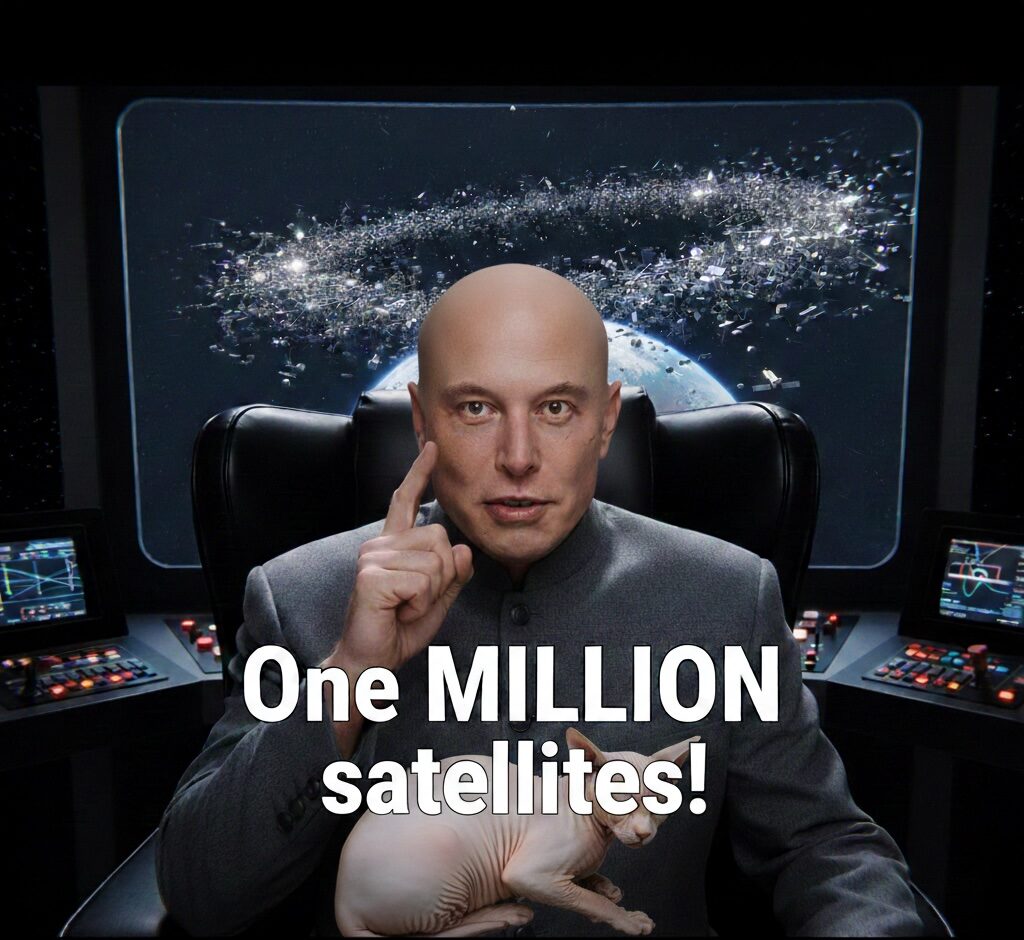
A Million Satellites? Seriously?
Always one to “aim high,” Elon Musk has outdone himself with this latest venture. As Eric Urbach expertly detailed in his recent Broadband Breakfast article, SpaceX filed an application with the FCC on January 30th requesting authorization to deploy up to ONE MILLION satellites in low Earth orbit. These new birds would function as orbital data centers for AI computing. That’s right, he wants to move SkyNet from fiction to reality (if it’s not already on its way).
Let that sink in for a moment. ONE. MILLION. SATELLITES.
To put this in perspective: the European Space Agency reports that approximately 16,910 satellites currently orbit Earth. As Eric points out, this single request would represent a 5,813% increase over the current satellite population. SpaceX currently operates around 9,400 functioning Starlink satellites, making this request a more than 100-fold expansion of their own operational scale.
The Proposal Details
According to the FCC filing, these satellites would operate at altitudes between 500 and 2,000 kilometers in sun-synchronous orbits to maximize solar power generation. SpaceX frames this as a solution to restraints on terrestrial data centers. The claim is that these orbital facilities would achieve “transformative cost and energy efficiency while significantly reducing the environmental impact associated with terrestrial data centers” by harnessing near-constant solar power.
The application notably lacks deployment timelines or cost estimates. Perhaps most tellingly, SpaceX requested waivers from FCC milestone requirements that typically mandate half of a constellation be deployed within six years. The reason? These milestones are unnecessary since they’d use Ka-band spectrum on a “non-interference, unprotected basis.”
The Audacity of It All
Musk positions this as humanity’s “first step toward becoming a Kardashev Type II civilization—one that can harness the Sun’s full power”. That’s quite the framing for what some industry analysts suggest might actually be a narrative tool for SpaceX’s upcoming IPO or its merger with xAI.
But here’s where my concerns escalate beyond the sheer hubris:
1. Resource Monopolization: Why would the FCC grant orbital rights to this magnitude to a single commercial entity? Imagine Thomas Jefferson taking the land acquired in the Louisiana Purchase and giving it all to a single property owner. This isn’t just about American airspace—Earth’s orbit is a global commons. How can the FCC unilaterally allocate this resource without international coordination?
2. Scientific Impact The astronomy community is sounding alarm bells. As early as 2024, astronomers warned that Starlink’s radio emissions were effectively blinding radio telescopes, severely impairing research capabilities. With satellite numbers potentially reaching into the hundreds of thousands or millions, the interference would increase exponentially, rendering certain types of astronomical observation extraordinarily difficult or altogether impossible.
3. The Kessler Syndrome Nightmare This is what keeps me up at night. The Kessler Syndrome—first proposed by NASA scientists Donald Kessler and Burton Cour-Palais in 1978—describes a scenario where the density of objects in low Earth orbit becomes so high that collisions cascade exponentially, with each impact creating more debris that triggers additional collisions.
In 2009, Kessler himself wrote that modeling results indicated the debris environment had already become unstable. We’re not talking about a Hollywood scenario that unfolds in 90 minutes. This would be a decades- or centuries-long process that could render certain orbital regions unusable for generations.
Even minuscule debris particles traveling at hypervelocity speeds of 7-15 km/s possess significant kinetic energy, posing severe threats to satellites and spacecraft. A cascade event could precipitate widespread internet and WiFi outages, and disrupt cellular, television, and GPS services—affecting approximately 68% of the global population (5.56 billion internet users).
The Bigger Questions
Perhaps most concerning is the timing and context. This filing comes as SpaceX eyes an $800 billion valuation and explores a potential merger with xAI ahead of a planned 2026 IPO. As cited in an article posted at SatNews, industry analyst Tim Farrar characterized the filing as “quite rushed” and likely a narrative tool targeting the massive capital needs of xAI rather than genuine broadband expansion.
Meanwhile, the FCC under Chairman Brendan Carr has historically been cautious with mega-constellation approvals, often granting licenses in smaller tranches to monitor collision risks and debris mitigation. They just approved 7,500 satellites for SpaceX earlier this month. How do we jump from that to one million?
The Bottom Line
I’ll say it again: KESSLER SYNDROME. If we’re not extraordinarily careful, we risk creating a debris field so massive that key orbital regions become inaccessible for generations. The economic, scientific, and technological implications would be catastrophic.
Earth’s orbit is not SpaceX’s personal sandbox. It’s a shared resource that enables critical infrastructure for the entire planet—communications, weather forecasting, GPS navigation, climate monitoring, and scientific research. The decision to populate it with one million satellites from a single company should require far more than an FCC filing. It demands international cooperation, rigorous environmental review, comprehensive debris mitigation plans, and serious consideration of long-term sustainability.
Perhaps the sheer audacity of the proposal is intentional—set the bar impossibly high so that whatever smaller number is eventually approved seems reasonable by comparison. But even a fraction of one million satellites carries profound implications for humanity’s relationship with space.
What do you think? Am I being overly cautious, or is this a justified concern about the privatization and potential degradation of a global commons?
https://broadbandbreakfast.com/spacex-seeks-fcc-approval-for-one-million-satellites-in-space/
#SpaceX #Starlink #SpaceDebris #KesslerSyndrome #FCC #Broadband #SpacePolicy #Sustainability