
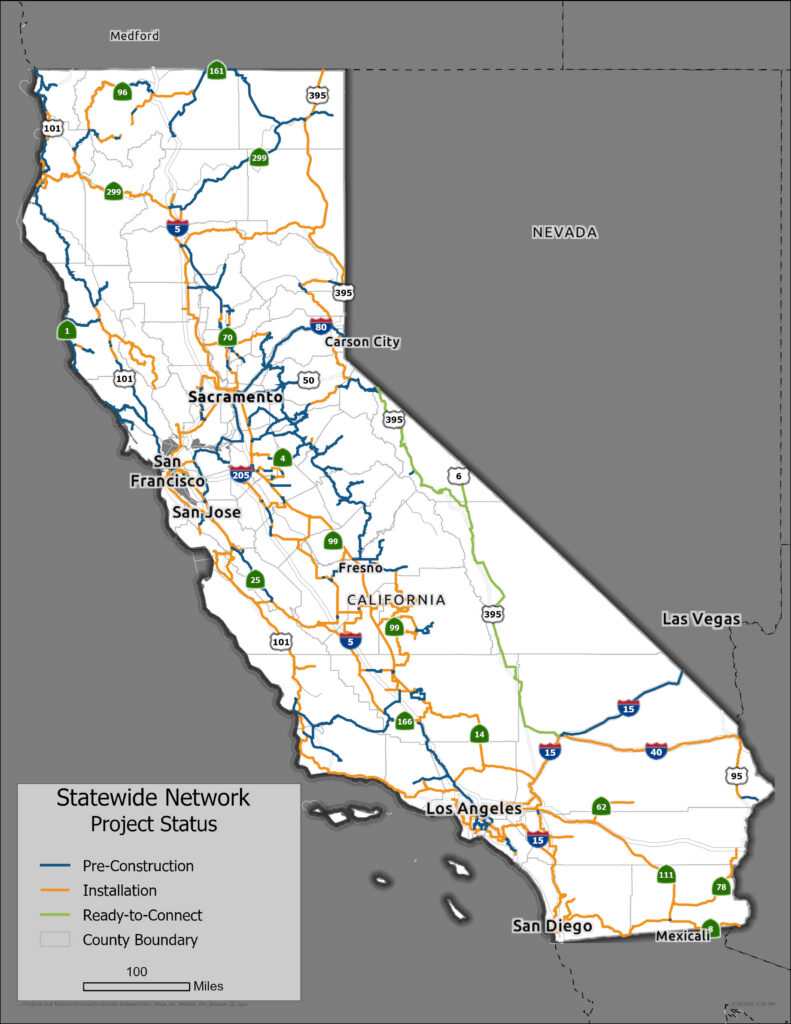
California’s digital backbone gets its first connection
On April 2, a quiet milestone with enormous implications unfolded in the high desert of the Eastern Sierra: the Bishop Paiute Tribe became the first community connected through California’s statewide middle-mile network — the largest publicly owned middle-mile infrastructure project in the United States.
It was a moment years — and billions of dollars — in the making.
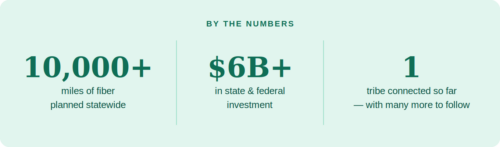
By The Numbers
What is the middle mile?
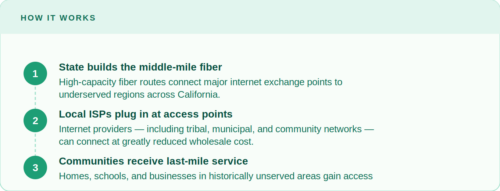
Broadband infrastructure has three layers. The “last mile” is the wire running into your home. The “backbone” is the long-haul internet highway spanning continents. In between sits the middle mile — the regional fiber arteries that connect backbone networks to local communities. In rural and tribal areas, this middle layer has historically been missing entirely, making last-mile buildout economically impossible for private internet service providers.
California’s solution was to build it themselves.
Why the Bishop Paiute Tribe matters
The Bishop Paiute Tribe, located in Inyo County along the eastern flank of the Sierra Nevada, sits in one of the most geographically isolated regions in the contiguous United States. Like many tribal nations, the community has long faced significant barriers to reliable internet access — a gap that carries real consequences for healthcare, education, economic development, and participation in modern civic life.
Their connection on April 2 wasn’t just a ribbon-cutting. It was a proof of concept — evidence that the infrastructure model works, and a signal to the hundreds of underserved communities still waiting that the network is real and coming.
“The largest publicly owned middle-mile network in the nation” is no longer a future promise — it is now an operational fact, with a community already online to prove it.
The road ahead
California’s middle-mile network — built under the California Department of Technology’s infrastructure mandate — is slated to ultimately reach tens of thousands of miles across the state, threading through rural valleys, mountain communities, tribal lands, and agricultural regions that private carriers have historically passed over.
The broader significance extends beyond California’s borders. As federal broadband funding from the Infrastructure Investment and Jobs Act continues to flow to states, policymakers are watching closely to see whether publicly owned middle-mile infrastructure can serve as a replicable model — one that makes universal connectivity not just an aspiration, but an engineering problem with a known solution.
The Bishop Paiute Tribe is online. The question now is how quickly the rest of the map can turn green.