
USF Reform Is Moving: What Community Providers Need to Watch This Summer
After years of near-misses and political stalemates, the Universal Service Fund may finally be approaching a reckoning on Capitol Hill. Lawmakers are aiming to circulate a discussion draft of legislation that would modernize the $8.5 billion-per-year Universal Service Fund this summer. For community-based providers whose financial models are built around USF support, the stakes could not be higher.
Why Now?
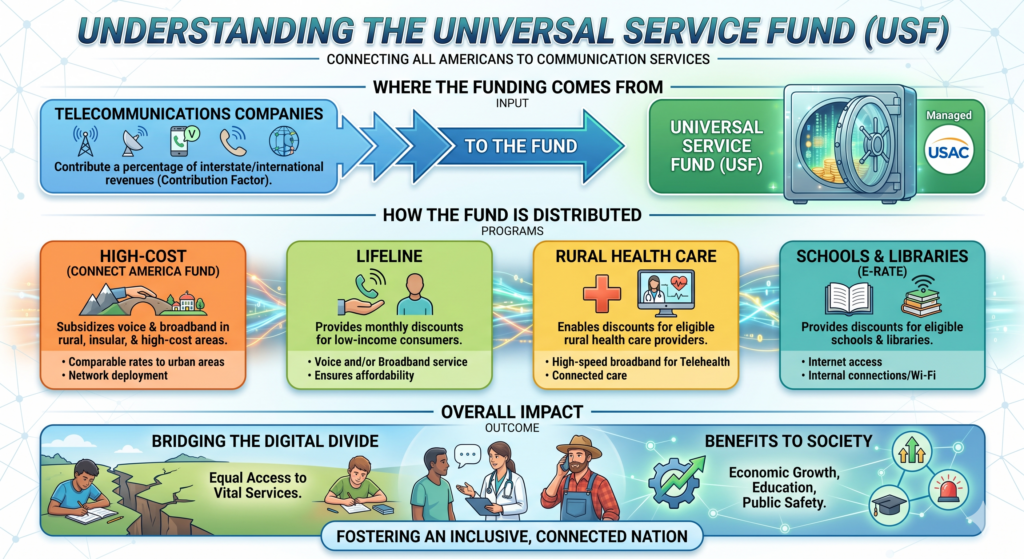
The pressure for reform has been building for years, and it’s now coming from multiple directions at once. The contribution factor — the percentage rate paid by telecom services — has skyrocketed from approximately 4% in 1998 to 37.0% for Q2 2026, as the traditional revenue base of interstate telecommunications shrinks while program costs remain steady. The contribution factor is likely to continue rising if Congress continues to do nothing.
The reason is structural: USF is funded by assessments on voice revenues — a market in steep decline. Meanwhile, the internet economy that depends on the rural broadband networks USF helps sustain contributes nothing to the fund. The math simply doesn’t work anymore.
A significant legal cloud was also removed last summer. In a 6-3 decision issued on June 27, 2025, the U.S. Supreme Court upheld the constitutionality of the USF contribution mechanism, rejecting arguments that Congress had impermissibly delegated its taxing power to the FCC. That ruling cleared the runway for Congress to act on reform without fear of undermining whatever they build.
Who Is Driving This?
The USF Working Group is led by Senators Deb Fischer (R-NE) and Ben Ray Luján (D-NM). The working group has been actively soliciting input from industry stakeholders over the past year, and the summer discussion draft represents the next tangible output of that process — the first real legislative text that providers will be able to respond to.
The Core Debate: Who Pays?
The central question in any USF reform is contribution reform — expanding the base of entities that fund the program. Two main camps have emerged:
- Broadband-only expansion: Add broadband internet access service revenues to the contribution base. Including broadband revenues would shrink the USF fee significantly by spreading the expense across a larger base.
- Big Tech / Edge Provider contributions: The Lowering Broadband Costs for Consumers Act (S.1651) would direct the FCC to reform the USF contribution system so that both broadband providers and edge providers contribute to the system. Edge providers — think streaming platforms, digital advertisers, and cloud companies — are heavy users of the rural networks USF helps sustain, yet currently contribute nothing.
What’s at Stake for Community Providers
The numbers are sobering. NTCA survey respondents reported receiving an average of more than $70 per month per broadband subscriber in USF support to help recover invested capital, repay loans, and cover operating expenses. If this support were lost, it could cause rural consumers’ rates to more than double what the average urban consumer pays for comparable services. Nearly two-thirds of respondents said they would need to cancel network deployment projects in 2026 and 2027 — equaling nearly $1.6 billion in total investment.
What to Watch
As the summer draft circulates, community providers should track three things closely: (1) whether the draft addresses contribution reform or kicks it to the FCC; (2) how the High-Cost Fund — the lifeline for rural deployment — is treated, since some reformers want to phase it out; and (3) whether any draft language creates new performance mandates or eligibility criteria that could affect smaller providers disproportionately. The discussion draft will be a starting point, not an endpoint — but it will set the terms of debate for everything that follows.
Sources: Broadband Breakfast (April 16, 2026); NTCA – The Rural Broadband Association; The CommLaw Group