
Iowa Emerges as AI Backbone Hub with Midwest FiberPath’s 1,200-Mile Fiber Corridor
Iowa Positioned as National Network Hub
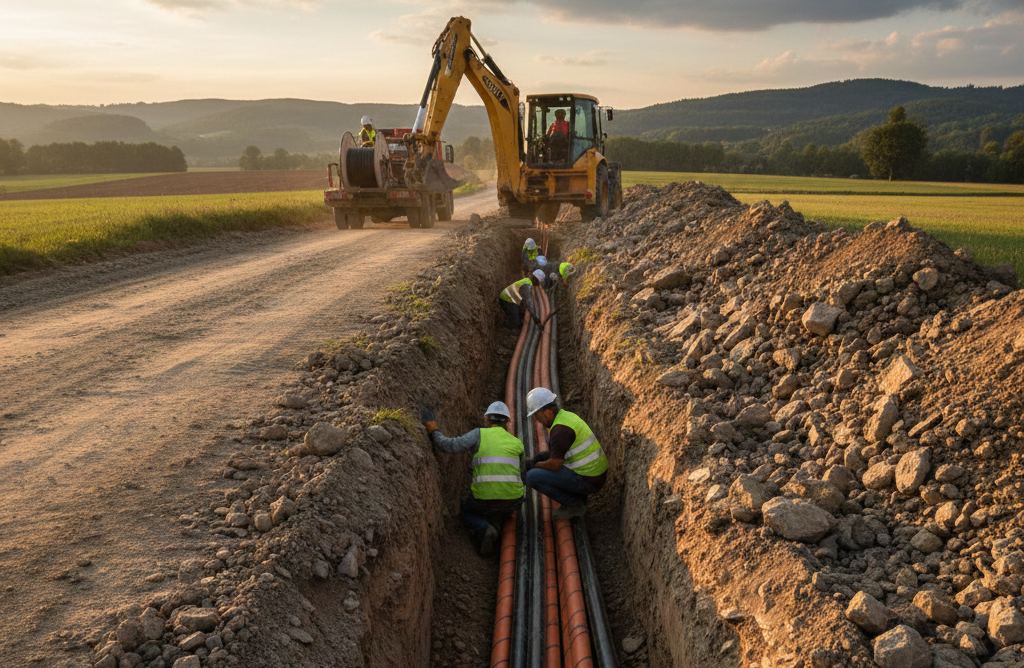
A Cedar Rapids-based startup is positioning Iowa at the center of the nation’s next-generation digital infrastructure map. Midwest FiberPath, LLC announced plans in February for a 1,200-mile, multi-conduit long-haul backbone engineered to support the explosive bandwidth demands of artificial intelligence workloads and hyperscale cloud computing across the central United States.
The project’s defining feature is its center-noded architecture — a four-direction topology that routes traffic through Iowa as a primary aggregation and redistribution hub rather than funneling it through the coastal chokepoints that have historically dominated U.S. network topology. By anchoring in Iowa, the platform aims to reduce congestion, improve resilience, and create a more geographically balanced national network fabric.
Railroad Rights-of-Way Power the Platform
Midwest FiberPath is a joint venture between Hawkeye Land Company, which contributes exclusive railroad rights-of-way across the region, and Anderson Pacific Capital, LLC. The railroad corridor routing is central to the platform’s design, minimizing latency and enabling a controlled right-of-way that supports dense fiber deployment without costly infrastructure redevelopment.
Three Corridors, One Unified Topology
Three primary corridors form the backbone’s structure. An east-west route connects Chicago-area interconnection ecosystems to Iowa compute campuses, running from Joliet, Illinois through Des Moines to Council Bluffs. A north-south corridor links Minneapolis and Kansas City through Des Moines, creating a regional mesh diversity path. A diagonal extension from Minneapolis through Cedar Rapids to Joliet reinforces Iowa’s role as a multi-directional exchange point. Together, the corridors create a grid-like redundancy uncommon in rural or central U.S. network infrastructure.
A Carrier-Neutral, Future-Ready Design
The platform is being built as a carrier-neutral, multi-duct conduit system capable of supporting dark fiber, high fiber-count cables, and future open line optical transport systems. The design philosophy deliberately avoids locking any single carrier or hyperscaler into proprietary technology, making it adaptable to evolving network standards as AI infrastructure requirements continue to scale.
“Our purpose-built architecture allows carriers and hyperscalers to deploy infrastructure with long-term flexibility while maintaining route diversity across one of the fastest-growing digital infrastructure regions in North America,” said Taylor Gates, IT Director at Midwest FiberPath.
What It Means for Rural Broadband Providers
For rural broadband providers in the Midwest, the project signals growing investment in the region’s long-haul transport layer — infrastructure that ultimately supports middle-mile and last-mile connectivity for communities across Iowa, Minnesota, Missouri, Illinois, and Nebraska. Midwest FiberPath is currently engaging carriers, cloud providers, and infrastructure investors to align deployment phases with projected AI-scale bandwidth demand.